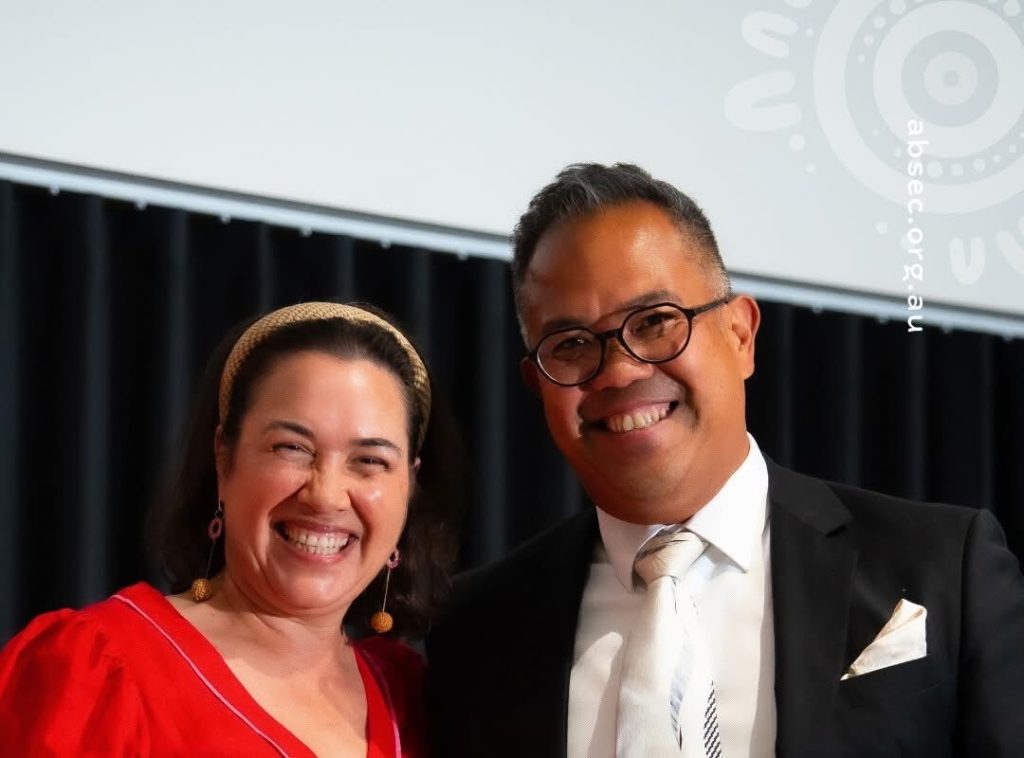
When AbSec presented me with the Walking Together Award, I felt two things at the same time. Gratitude, and a quiet weight in my chest. The theme for the night was Honour the Past, Empower the Present, Shape the Future. It was a reminder that children are sacred. They carry tomorrow inside them. And our job is to protect that future with the choices we make today.
Catherine Liddle, CEO of SNAICC, stood beside me when the photo was taken. Her words from the stage stayed with me. She spoke about the singing and dancing, the joyful parts of culture where children feel safe. She also reminded us that sometimes we have to create storms to fight for what children need. Both truths sit together in this work.
Those words landed even harder because of what I had read earlier that week.
The Australian Childhood Foundation released a media statement saying what many of us see every day. Residential care is failing too many children. Some receive no therapeutic support. Some are left unsafe. Some are pushed into deeper harm.
Young people themselves said this clearly in their 2025 study. Healing depends on adults who listen, who notice, who stay consistent. Yet many still live with placement churn, high staff turnover, rigid rules and a lack of cultural connection.
They are asking us to move as one.
Not as isolated parts.
The Cost of Fragmented Care
Children in OOHC carry more than their own stories. They carry the movement of the adults around them. When support teams shift constantly, children absorb that instability into their sense of self.
They feel the gaps between programs.
They feel the tension between agencies.
They feel the silence when adults fail to talk to each other.
The neuroscience is clear. A child’s brain settles when the world around them is steady. Consistency grows trust. Predictability builds identity. Connection helps the stress system reset.
But many children are left to make sense of chaos alone.
The Boy Who Showed Me What Steady Adults Can Change

Years ago I met a boy who had moved through more homes than birthdays. Some stays were in hotel rooms with rotating staff he had never met. Workers changed every few hours. Rooms changed every few days. He learned to keep his bag packed.
Every placement breakdown felt like a verdict on him.
He believed he was too much.
Too angry. Too hard.
He carried that blame quietly.
Every time trust began to form, a handover wiped the slate clean. New faces. New rules. New tone. His nervous system never had a chance to settle.
Then something shifted.
A coordinated care system was finally placed around him.
Adults moved together.
They shared notes in real time.
They checked in before changing routines.
They kept his kin involved.
School staff and clinicians moved in step instead of in parallel.
Within weeks he slept longer.
He walked into school with less tension in his shoulders.
His arguments softened because he no longer needed to defend himself at every moment of the day.
He didn’t suddenly change.
The adults did.
And his body responded to that steadiness.
What This Teaches Us About A Child’s Brain
A child’s brain is always trying to pull scattered experiences into something coherent. When adults move in fragments, a child absorbs that fragmentation. When adults move together, a child finally gets the chance to grow.
The Australian Childhood Foundation called this out clearly. Children need recognitional practices. They need empathy. They need adults who learn them. They need coordinated support that actually feels like support.
We cannot ask a child to settle in a world that never settles around them.
We cannot ask for trust when adults rotate before trust can form.
What This Means For Relational Minds
Relational Minds was built with one guiding belief.
Children cannot hold their stories alone.
The adults around them must hold those stories too.
This is why our work with OOHC children looks different.
We stay in their lives even when they move regions.
We stay connected even when they cross jurisdictions.
We keep their plan active.
We keep their history intact.
We know how much harm comes from making a child retell their pain.
We know how much safety comes from hearing a familiar voice at the other end of a screen or phone.
We know how powerful it is when a child realises the adults around them are not changing again.
This is not convenience.
It is therapeutic care.
It is the thing that lets children breathe.
Our internal practice reflects this.
Clinicians communicate daily.
We use shared language.
We keep families in the centre.
We involve schools, kin, and other services in real time.
We act as one team so the child does not have to join the pieces themselves.
Consistency is not a goal for us.
It is the work.
The Role of Community and Culture
I cannot talk about this award without acknowledging the leadership that shaped my thinking.
Thank you to Burrun Dalai Aboriginal Corporation for your friendship, trust, and vision. You have shown me what culturally grounded care looks like when it is done with wisdom and heart. You lead with culture, with kinship, with community. You show what steady support looks like for children who have lived through far too much instability.
I am grateful to walk alongside you.
Why This Award Matters, and What Comes Next

The Walking Together Award recognises partnership. It acknowledges non Aboriginal agencies that work with Aboriginal communities to design and deliver support that actually improves outcomes. It is not about heroism or individual achievement. It is about shared responsibility.
The future of OOHC cannot be built on fragmented care.
Not when children are living with the effects every day.
Not when culture already shows us what connected care looks like.
Not when children tell us, clearly, what they need from us.
Children need adults who move in step.
Adults who speak to each other.
Adults who stay long enough for trust to form.
Adults who act as one circle around them, not many separate parts.
This is the future I want Relational Minds to help shape.
A future where children do not lose support every time they lose an address.
A future where therapeutic care is not optional.
A future where culture guides our decisions, not paperwork.
A future where children can finally stop bracing for the next shift.
If something in this story resonates with your own practice or your care for children, I would love to stay connected. These conversations shape the direction of our sector. And they shape the futures of the children we stand beside.
Let’s keep walking together.